

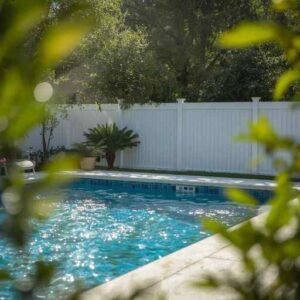

Pool Safety in MA
What MA Pool Owners Need to Know to Keep Children and Pets Safe Every Season
Authorized Protect-A-Child Dealer
Serving MA Homes & Businesses
5-Star Rated Installations
Professionally Installed
American-Made Product
The Risk Is Real - Safety Starts At Home...
Drowning is the leading cause of accidental death in children ages 1 to 4 in the United States — and the majority of backyard drownings happen in a family’s own pool, with a parent or caregiver nearby. In most cases, the child was out of sight for fewer than five minutes.
In Massachusetts, pool season runs May through September — and for those five months, an unprotected backyard pool is one of the most serious hazards a family can have on their property. The good news is that drowning is almost entirely preventable. A properly installed, code-compliant pool fence is the single most effective physical barrier between a child and a pool — more reliable than supervision alone, and more effective than any alarm or cover.
At MValley Fence, we install Protect-A-Child pool safety fences across Exxes & Middlesex Counties in Massachusetts because we know that the right barrier saves lives. This page will walk you through everything you need to know as a Massachusetts pool owner — the law, the layers of protection, what makes a fence truly safe, and the mistakes most homeowners make.
Massachusetts Pool Fence Requirements — What the Law Requires
Massachusetts state law requires a compliant safety barrier around residential swimming pools.
Here is what every MA pool owner needs to know:

Massachusetts Pool Fence Requirements — What the Law Requires
Massachusetts state law requires a compliant safety barrier around residential swimming pools.
Here is what every MA pool owner needs to know:
- Any pool, spa, or hot tub that can hold water more than 24 inches deep requires a compliant barrier. (This water-depth trigger is the actual code standard — more precise than “all in-ground pools regardless of depth.”)
- In-ground pools require a barrier, since they always exceed that depth.
- Above-ground pools with a wall less than 48 inches high require an added barrier (a fence).
- Above-ground pools with a wall 48 inches or taller may use the pool wall itself as the barrier — but any ladder or steps must be removable, lockable, or blocked by a self-closing, self-latching barrier when the pool is not in use.
- Hot tubs and spas are exempt only if fitted with a lockable safety cover that meets ASTM F1346.
- The barrier must be at least 48 inches high, measured from finished grade on the outside (the side facing away from the pool).
- The gap between the ground and the bottom of the barrier cannot exceed 2 inches on the outside. (Where the barrier sits on top of an above-ground pool structure, the gap to the bottom of the barrier cannot exceed 4 inches.)
- No opening in the barrier may allow a 4-inch sphere to pass through. (Your current “no more than 4 inches between openings” is close; the code phrases it as the 4-inch-sphere rule.)
- The barrier must be non-climbable from the outside — no horizontal rails, footholds, or handholds a child could use to scale it. Where a fence has horizontal members less than 45 inches apart, they must be on the pool side.
- Solid barriers may have no indentations or protrusions that serve as handholds or footholds.
- Chain-link and lattice openings are limited to small dimensions (roughly 1¾ inches) — confirm the exact figure with your building department, since it varies slightly by material and code cycle. Mesh safety fences like Protect-A-Child satisfy this through the 4-inch-sphere rule.
- All gates must be self-closing — the gate returns to closed on its own with no manual help.
- All gates must be self-latching — the latch engages automatically when the gate closes.
- Gates must swing outward, away from the pool, so a child pushing against the gate cannot force it open.
- Latch placement depends on height: if the latch release is 54 inches or more above the ground, it can sit anywhere on the gate. If the release is lower than 54 inches, it must be on the pool side, at least 3 inches below the top of the gate, with no opening larger than ½ inch within 18 inches of the release — so a child cannot reach through to work the latch.
- Every gate should be lockable, and pedestrian gates should be the primary self-latching access point.
A Note on Local Ordinances
MA state code sets the minimum standard, but your municipality may have stricter requirements. Some towns require a building permit before pool fence installation. Always check with your local building department before installation. MValley Fence can provide documentation of your fence layout and specifications to support any permit application.
Pool Safety Works in Layers — A Fence Is the Foundation
No single safety measure is foolproof on its own. Pool safety professionals recommend a layered approach — multiple overlapping barriers so that if one fails, another catches the risk. Here is how the layers work together:
Layer 1 — Physical Barrier (Pool Fence)

The most critical layer. A properly installed, code-compliant pool fence prevents unsupervised access to the pool entirely. It does not rely on anyone remembering to do something — it simply works, every time, as long as the gate is closed. This is the layer that Massachusetts state law mandates, and for good reason. → Learn about our pool fence installation or removable pool fence options.
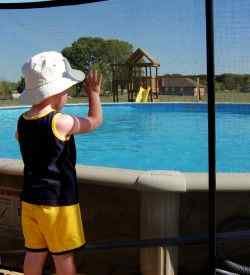
Layer 2 — Pool Alarms
Pool alarms provide an audible alert when someone or something enters the water or passes through a door or gate. There are three main types:
Surface wave alarms — detect disturbance in the water and trigger an alarm inside the home
Door and gate alarms — alert when a gate or door leading to the pool area is opened
Wearable wristband alarms — worn by young children; trigger when submerged
Pool alarms are a valuable second layer but should never replace a physical fence. Alarms require batteries, can malfunction, and produce false positives that condition adults to ignore them.
Layer 3 — Safety Pool Covers
A motorized or anchored safety pool cover rated to support adult weight provides an additional barrier when the pool is not in use. Standard solar covers and winter tarps are not safety covers — they can trap a child underneath and are more dangerous than no cover at all. If you invest in a cover, make sure it carries a ASTM F1346 safety certification.
Layer 4 — Swim Lessons
Children who have had formal swim lessons have a significantly lower risk of drowning. The American Academy of Pediatrics recommends swim lessons beginning as early as age 1 for most children. Water confidence and basic survival swimming skills are meaningful additional protection — but they are not a substitute for physical barriers. Even strong swimmers drown.
Layer 5 — Active Supervision
A designated “water watcher” — an adult whose sole responsibility is watching the pool, with no phone, no conversation, and no distractions — is the last line of defense when children are in the water. The water watcher role should rotate every 15 to 20 minutes to maintain focus. When children are not actively swimming, the water watcher rule still applies if they are anywhere near the pool area.

Not All Pool Fences Are Equal — What to Look for
A decorative fence and a safety fence are not the same thing.
Here is what separates a truly protective pool barrier from one that simply looks the part:
Non-climbable design — mesh fences provide no footholds or handholds. Aluminum picket and wrought iron fences have horizontal rails that curious children can climb like a ladder
Minimum 48″ in height — taller is better. A 5-foot fence provides significantly more protection than a fence that just clears the minimum
Strength under force — a pool fence must withstand a child pushing, pulling, or hanging on it without bending, racking, or pulling free of its posts. Protect-A-Child I-Beam composite posts are engineered to resist over 160 lbs of force
Self-closing, self-latching gate — the gate is the most critical component. A gate that relies on someone remembering to close it will eventually be left open. Magna-Latch and Tru-Close spring hinges ensure the gate closes and latches every single time
Visibility through the fence — super-transparent mesh allows full sight lines to the pool from inside the home. Solid privacy fences or dense plantings actually reduce safety by blocking the view
No gaps at ground level — the fence must sit close enough to the ground that a child cannot roll or squeeze underneath. Any gap greater than 4 inches is a code violation and a safety risk
Proper post depth and surface anchoring — posts must be anchored securely enough that the fence cannot be pushed over or pulled free at the base
Ready to Add the Most Important Layer of Protection?
A properly installed Protect-A-Child pool fence is the most effective single step you can take to protect your family.
Get a free on-site estimate from MA’s authorized installer – MValley Fence.
Pool Safety Mistakes MA Homeowners Make — And How to Avoid Them
Relying on supervision alone — even attentive parents are distracted. The CDC reports that in most backyard drownings, a supervising adult was present but briefly looked away. A fence works even when you don’t
Using a decorative or agricultural fence as a pool barrier — a split-rail fence, picket fence with wide spacing, or chain-link fence with climbable links does not meet MA pool code and provides minimal real protection
Propping the gate open — “just for a minute” is how accidents happen. A self-latching gate solves this problem permanently

Leaving above-ground pool ladders accessible — when the pool is closed for the day, remove or lock the ladder. An above-ground pool wall is only a barrier if access to it is controlled
Assuming a pool cover replaces a fence — a standard solar cover or winter tarp is not a safety device. A child can be trapped beneath it. Only ASTM-certified safety covers provide any meaningful protection, and they still do not replace a fence
Ignoring fence damage or wear — a bent post, a broken panel, or a latch that no longer catches reliably turns your safety fence into a false sense of security. Inspect your fence at the start of every pool season and after any major storm
Not having a designated water watcher — “everyone is watching” means no one is watching. Assign one adult per swim session
What Mass Homeowners Are Saying...

Speed was an important factor to us since the home didn't have a fence and we have pets that needed a safe place to roam, so we're really grateful that they were able to make things work so quickly and hammer out the project in a single day.
Great experience overall, and I'll definitely work with them again if I have future fence installation needs.



He was able to work around several trees and their roots, secured the posts way better than what was original there, and even made the panels far more even than they were in height. He was communicative the whole way from start to finish and respectful of our time.
When it comes time to repair other sections of the fence or replace it in the future we will definitely call him again. Thanks Bill!

If you are looking for a new install, repair, or replacement, MValley Fence is the way to go.


Pool Safety FAQs
Is a pool fence required by law in Massachusetts?
Yes. Massachusetts requires a compliant safety barrier around residential pools under the state building code (780 CMR). The fence must stand at least 48 inches high, resist climbing, and use a self-closing, self-latching gate that swings outward away from the pool. If your pool has no barrier or an outdated one, you carry both a fine risk and liability exposure if someone is injured on your property. MValley Fence gives free on-site estimates across Essex and Middlesex County and can check whether your current setup meets code.
Do I need a permit for a pool fence in MA?
Usually, yes. Massachusetts administers pool barrier rules through local building departments, so most towns require a building permit before installation, though requirements and fees vary. Check with your local building department first. We provide written specifications and a layout plan to support your permit application.
What is the minimum height for a pool fence in MA?
The minimum is 48 inches, measured on the outside — the side facing away from the pool — and the fence must be non-climbable from that side. 48 inches is the legal floor, not the safest choice: the CDC recommends a 5-foot fence for households with children under 5, since taller fences are harder to scale. The Protect-A-Child system we install meets and exceeds the MA minimum.
Does the gate need to be the same height?
Yes. The gate must match the fence height and stay self-closing and self-latching. A gate shorter than the fence creates a climbable weak point in the barrier.
What type of pool fence is safest for young children?
The minimum required height for a pool fence in Massachusetts is 48″. The fence must be measured on the outside — the side facing away from the pool — and must be non-climbable from that side. While 48″ is the legal minimum, safety professionals and the CDC recommend a 5-foot fence for households with children under 5, as taller fences are significantly harder to scale. The Protect-A-Child system installed by MValley Fence meets and exceeds MA minimum height standards.
Does the gate need to be the same height?
Yes — the gate must match the fence height and must be self-closing and self-latching. A gate that is shorter than the fence creates a climbable weak point in your barrier.
What type of pool fence is safest for young children?
A mesh pool fence. Aluminum picket, wrought iron, and chain-link fences have horizontal rails or links a child can climb like a ladder; mesh gives no footholds or handholds, so a child cannot climb a properly installed mesh fence. The Protect-A-Child system uses super-transparent mesh that keeps the pool in full view from inside the home, and a Point-Lock child-safe latch that children cannot work open.
How young is “too young” for a pool fence to matter?
There is no age floor. Drownings involving children under one year old have been documented. Install the fence before any child, at any age, can reach your yard.
How effective is a pool fence at preventing drowning?
A four-sided fence that fully isolates the pool from the rest of the yard, including the house, reduces the risk of childhood drowning by about 83% according to the CDC. Three-sided fences that use the house as the fourth wall are far less effective, because a child can still reach the pool through a door. A complete four-sided barrier with a self-latching gate is the standard we build to on every installation, unless site conditions prevent it — in which case we walk through alternatives at the free estimate.
Is a pool fence more effective than a pool alarm?
Yes, by a wide margin. A fence stops a child from reaching the water; an alarm only sounds after the child is already in it. Use both as layers, but the fence is the foundation.
At what age can a child safely be around a pool without a fence?
There is no age at which a child is safe around an unfenced pool without direct supervision. Even strong swimmers — teenagers and adults included — can face sudden incapacitation, panic, or exhaustion in the water. For children under 5, the American Academy of Pediatrics is direct: a four-sided pool fence is required. For older children, the fence still guards against visiting children, neighborhood children, and any child who reaches your yard without your knowledge.
When is it safe to remove a removable pool fence?
Take a removable Protect-A-Child fence down only when no children are present and an adult is directly supervising the pool. The system is built for that flexibility — sections lift out in minutes and go back just as fast.
Does a pool cover count as a safety barrier in MA?
No. A standard pool cover does not satisfy Massachusetts barrier requirements — only a code-compliant fence with a self-closing, self-latching gate qualifies. Safety covers that meet the ASTM F1346 standard add a layer of protection but do not replace a fence. Standard solar covers and winter tarps offer no safety protection and can raise the drowning risk by trapping a child underneath. If you use a safety cover, use it alongside your fence, not instead of it.
Protect Your Pool. Protect Your Family.
A pool fence is not just a code requirement — it is the most reliable safety decision you can make as a pool owner in Massachusetts.
Contact MValley Fence today for a free, no-obligation pool safety fence estimate anywhere in Middlesex and Essex Counties. We will measure your pool, plan your custom layout, and give you a clear written quote the same day — no pressure, no surprises.