

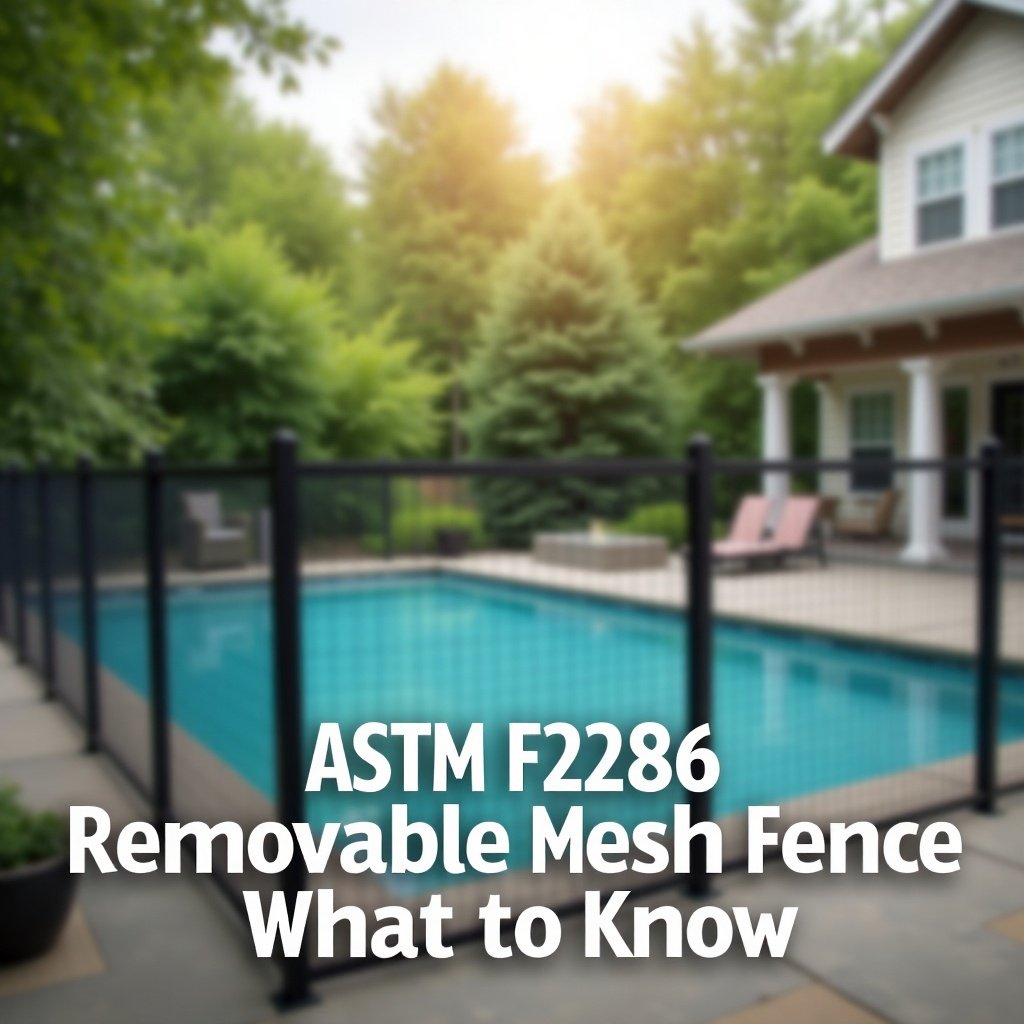
If you own a pool or manage a property where child safety is a priority, you have probably encountered the term ASTM F2286 at some point. This certification standard governs removable mesh fences designed specifically to prevent unsupervised access to swimming pools and other hazardous areas. Understanding what this standard means, and why it matters, can help you make a smarter, safer decision for your property.
A removable mesh fence is not just a temporary barrier you set up and forget. It is a carefully engineered safety system that must meet specific performance requirements to earn ASTM International certification. Many homeowners are surprised to learn that their insurance policy or local regulations may require a compliant fence. If you are wondering whether your coverage is affected, reviewing what insurers typically expect around pool barriers is a practical first step before purchasing any fencing system.
This guide walks you through everything you need to know about ASTM F2286 certified removable mesh fences, from what the standard actually requires to how to choose, install, and maintain the right product for your situation. Whether you are a homeowner, a contractor, or a property manager, the information here will help you stay compliant, protect the people you care about, and get the most value from your investment.
What an ASTM F2286 Certified Removable Mesh Fence Is
Core definition and intended use
ASTM F2286 is a performance standard published by ASTM International that defines the minimum requirements for removable mesh fences used as pool safety barriers. The standard applies specifically to portable fence systems that can be installed and removed without permanent ground anchors or concrete footings. These systems are designed to create a reliable perimeter around swimming pools, spas, and other water features where unsupervised child access poses a drowning risk.
The primary intended use is residential pool safety, though the fence also functions effectively as a temporary fencing solution in other settings. Unlike a chain link fence or a permanent galvanized steel fence, a removable mesh fence is engineered for repeated assembly and disassembly without compromising structural integrity.
| Feature | ASTM F2286 Requirement | Purpose |
|---|---|---|
| Minimum height | 48 inches | Prevents climbing by young children |
| Mesh opening size | No larger than 1.75 inches | Limits hand and foot holds |
| Post spacing | Specified by manufacturer | Maintains panel rigidity |
| Gate latch | Self-closing, self-latching | Reduces accidental entry |
| Load resistance | Defined force thresholds | Structural stability under pressure |
How certification relates to safety and compliance
Fence certification under ASTM F2286 is not just a marketing label. It means the product has been tested against measurable performance benchmarks covering structural load, mesh integrity, and gate function. Products that carry this certification have demonstrated they can resist the forces a child might apply when attempting to climb or push through the barrier.
Fence compliance with ASTM F2286 also matters for legal and regulatory reasons. Many local building codes and state safety standards reference this certification directly. In Massachusetts, for example, understanding how state pool regulations apply to private residential pools can clarify exactly what type of barrier is legally required on your property.
Choosing a non-certified fence may save money upfront but can expose you to liability, insurance complications, and code violations. Safety standards exist because they work, and ASTM International has a long track record of developing rigorous, evidence-based benchmarks for consumer and industrial products.
Key Features, Materials, and Design Considerations
Mesh structure, posts, and removable components
The mesh used in an ASTM F2286 certified removable mesh fence is typically made from high-density polyethylene or a similar UV resistant material. The weave is tight enough to prevent small fingers from gaining a foothold, which is a critical safety feature. Fence panels connect to steel fence posts that are inserted into ground sleeves, allowing the entire system to be removed and reinstalled without damaging the surrounding surface.
The removable components are engineered for durability despite their portable nature. Posts are usually made from powder-coated aluminum or galvanized steel, offering corrosion resistance without excessive weight. Each fence panel is designed to lock securely into adjacent panels, creating a continuous perimeter with no gaps.
Durability, visibility, and weather resistance
A quality removable mesh fence must hold up against sun, rain, wind, and temperature fluctuations. UV resistant fence materials prevent the mesh from becoming brittle or faded after prolonged sun exposure. This matters because a degraded mesh may no longer meet the structural requirements of the ASTM F2286 standard, even if it looks intact from a distance.
High visibility fence designs use colors like black or dark green that contrast with pool surroundings, making it easier for adults to see children near the barrier. Wind load rating is another important consideration, particularly in coastal or open areas where gusts can stress fence panels and posts. Manufacturers who meet ASTM F2286 requirements typically publish wind load data for their products.
Installation environment and site-specific requirements
Not every yard or pool deck is the same, and the installation environment significantly affects how a removable mesh fence performs. Hard surfaces like concrete or pavers require sleeve anchors, while grass or soil installations use driven ground sleeves. The type of surface determines which hardware is appropriate and how stable the fence will be once installed.
Perimeter security also depends on how well the fence accounts for irregular terrain, steps, and existing landscaping. Fence panels can often be adjusted or cut to accommodate unusual layouts, but this must be done carefully to avoid compromising the structural integrity that ASTM F2286 certification requires. Always follow manufacturer guidelines for site-specific modifications.
Practical Benefits, Limitations, and Use Cases
Pool safety, temporary barriers, and family-friendly protection
The most common use case for an ASTM F2286 certified removable mesh fence is residential pool safety. Parents and grandparents use these systems to create a reliable barrier between young children and pool water. The fence can be removed when adults are present and supervising, then reinstalled quickly when the pool area needs to be secured again.
Beyond pool safety, these fences serve as effective temporary fencing in a variety of settings. They are used as pedestrian barriers at outdoor events, as construction site fences to restrict access to hazardous work zones, and as crowd control barriers at public gatherings. The portable fence design makes it practical for applications where a permanent structure is not feasible or desirable.
Advantages for property owners and installers
Property owners benefit from the flexibility that a removable mesh fence provides. Unlike a permanent chain link fence or wood fence, this system does not require permits in most jurisdictions and does not alter the visual character of the yard permanently. It can be stored during off-season months and reinstalled when needed.
- No concrete footings required, reducing installation time and cost
- Panels are lightweight and manageable for one or two people
- Compatible with fence rental programs for short-term needs
- Fence accessories like gates and corner posts are widely available
- Meets safety standards required by many insurance providers
- Suitable for industrial fencing applications with appropriate configurations
For professional installers, the system is straightforward to learn and efficient to deploy. Fence installation typically takes a few hours for an average-sized pool, and the process does not require specialized tools or heavy equipment.
Common drawbacks and maintenance concerns
No fencing system is perfect, and removable mesh fences have real limitations worth understanding. The mesh can accumulate debris, leaves, and algae over time, which affects both appearance and airflow. If the mesh becomes clogged or damaged, it may need to be replaced to maintain compliance with ASTM F2286 standards.
- Posts can loosen in soft or sandy soil over time
- Mesh panels may sag if not tensioned correctly during installation
- Gate hardware requires regular lubrication to function properly
- Repeated removal and reinstallation can wear down sleeve anchors
- Not suitable as a permanent perimeter security solution in high-risk areas
The fence is also not designed to stop determined adults or large animals. It is a child safety barrier, not a security fence, and should be understood as one layer of a broader safety strategy.
How to Choose, Install, and Maintain the Right Fence
What to verify before buying
Before purchasing any removable mesh fence, confirm that the product explicitly states ASTM F2286 certification. Some manufacturers use vague language like “meets safety standards” without specifying which standard. Ask for documentation or look for third-party testing verification from a recognized laboratory.
- Confirm the fence height meets or exceeds 48 inches
- Check that mesh openings are no larger than 1.75 inches
- Verify the gate is self-closing and self-latching
- Review the wind load rating for your geographic area
- Ensure the manufacturer offers replacement parts and fence accessories
- Compare warranty terms across competing portable fence brands
Buying a certified product from a reputable supplier protects you legally and practically. It also ensures that replacement components will be compatible if you need to expand or repair the system later.
Installation best practices and common mistakes
Proper fence installation starts with measuring the perimeter accurately and planning post placement before drilling any holes. Spacing posts too far apart reduces panel rigidity and may cause the fence to flex under pressure. Follow the manufacturer’s recommended post spacing precisely, especially around gates and corners where stress concentrates.
Common mistakes include installing sleeves at inconsistent depths, which causes posts to sit at uneven heights, and failing to tension mesh panels properly between posts. A loose or sagging panel looks unsecured and may actually be easier for a child to push through. Take time to check each panel after installation and adjust as needed.
Inspection, cleaning, and long-term care
Regular inspection is essential for maintaining both safety and fence compliance over time. Check posts for looseness, inspect mesh for tears or holes, and test the gate latch every few weeks during active use periods. Any component that shows wear or damage should be replaced promptly rather than left in place.
Cleaning the mesh with mild soap and water removes algae, dirt, and pool chemical residue that can degrade the material over time. Avoid harsh solvents or pressure washing at close range, which can damage the UV resistant coating. When storing the fence during off-season months, keep panels flat and dry to prevent warping or mold growth.
Conclusion
An ASTM F2286 certified removable mesh fence is one of the most practical and effective tools available for pool safety and temporary perimeter control. It combines genuine safety performance with the flexibility that homeowners and property managers need. Choosing a certified product, installing it correctly, and maintaining it consistently gives you a barrier you can trust.
The standard exists for good reason, and the products built to meet it reflect that purpose. Invest in certification, follow the installation guidelines, and inspect the system regularly. That combination delivers real protection, not just the appearance of it.
FAQ
What does ASTM F2286 certification indicate?
ASTM F2286 certification indicates that a removable mesh fence has been tested and verified to meet specific performance requirements set by ASTM International. These requirements cover mesh opening size, fence height, gate function, and structural load resistance. A certified fence has demonstrated it can function as a reliable child safety barrier under defined conditions.
Is a removable mesh fence suitable for every pool area?
A removable mesh fence works well in most residential pool settings, but site-specific factors like surface type, terrain, and local regulations can affect suitability. Very uneven ground, large gaps under existing structures, or unusually high wind exposure may require additional planning or alternative solutions. Always assess your specific site conditions before selecting a fence system.
How often should the fence and hardware be checked?
Inspect the fence and all hardware at least once a month during periods of regular use. Pay particular attention to post stability, mesh integrity, and gate latch function. After severe weather events, conduct an additional inspection to check for storm-related damage. Consistent inspection habits are the most reliable way to ensure the fence continues to meet ASTM F2286 safety standards over time.